Thursday, May 4, 2023

Hiroshima

Greetings friends,

Today's post is going to be a little bit on the somber side. Ever since coming to Japan I had wanted to visit the place where the first ever atomic bomb was used in conflict. I wanted to experience standing at the epicenter of one of mankind's most heinous and cruel acts against itself, and I wanted to understand how humanity is capable of such disregard for human life. While staying in Osaka, I asked my brother if he was ok with a daytrip to Hiroshima and he immediately agreed.

We took the bullet train to travel the 330 km in a little under 1.5 hours, which was mind-blowing in itself, albeit for a different reason. From Hiroshima main station it is a short 17 minute ride by street car to the Atomic Bomb Dome, which in Japanese is called 原爆ドーム, or "Genbaku Dōmu". "Genbaku" means "atomic bomb" in Japanese, but the characters that make up the word individually have the meanings of "original" and "explosion".

The monument is kept in a state of arrested ruin, to look just as it had directly after the detonation. Metal beams are broken and deformed, and rocky debris still lies scattered in and around the husk of the building formerly known as the Prefectural Industrial Promotion Hall. The site is located in what once was the city's busiest district and today is the Peace Memorial Park. At its heart you can find the cenotaph for the direct and indirect victims of the explosion.


A concrete saddle protects from weathering a kind of sarcophagus containing the names of the over 140,000 people that had lost their lives. The view through the saddle centers the flames of peace directly in front of the dome. The inscription reads in English: "please rest in peace, for [we/they] shall not repeat the error". The subject is omitted. The Japanese language does not use pronouns you see, which is one of the reasons westerners like me struggle so much learning it.

Not far from the dome you can find the Atomic Bomb Memorial Mound. Here, the ashes of 70,000 unidentified victims are buried. Unfathomable.


Wandering through the park, ever so often you could hear the sound of a bell being carried throughout. It didn't take us long to find the source: The Bell of Peace.


Here a plaque asked us to toll the bell, as presumably many other visitors did as we could hear the sound so frequently. The inscription read:

Bell of Peace
We dedicate this bell
As a symbol of Hiroshima Aspiration:
Let all nuclear arms and wars be gone,
and the nations life in true peace!
May it ring to all corners of the earth
to meet the ear of every man,
for in it throb and palpitate
the hearts of its peace-loving donors.
So may you, too, friends,
step forward, and toll this bell for peace!

Tears were a common occurrence for me then as they are now while writing this post. I truly hope humanity will learn from its errors, but my confidence therein is constantly shaken. Unless we can cure the hatred between this world's peoples, we are doomed to repeat the uncountable errors of our history.

May the fourth be with you,
Nils

Monday, March 27, 2023

Osaka

Hellloooooo,

And welcome to Osaka! 

THAT is the Glico running man. This sign has been hanging here in various configurations since 1935 and has become a famous landmark of Osaka. To be honest, we kind of stumbled across it while strolling through the city and looking for some food. Even though it was raining that day the city was bustling with people and there were long lines in front of the food places.

Eventually we found a place. We weren't looking for something specific but when we saw that this store had a huge bowl of fried noodles, aka "Yakisoba", we simply didn't have a choice.

Even though it was meant for ten people, the two of us devoured the whole thing. It was delicious, but not an easy feat. 

Osaka really is an awesome place for going out. The little alleyways all have a charm of their own. Just look at this one which was basically located at the doorstep of our hotel.

This alone should be reason enough for a visit but the city has a lot more to offer. If you are into history like myself you will find that this city's past is rich. There is for example Osaka Castle, the seat of power of Toyotomi Hideyoshi, the second of the three unifiers of Japan.

He was born as the son of a lowly peasant and worked himself up, as a retainer of Oda Nobunaga (the first of the trio), to be the most powerful warlord in the time of the Warring States, the Sengoku-Jidai (1467-1568). He chose Osaka as his stronghold and built a mighty castle.


From here he completed the unification that his former master started. The castle however was sieged and eventually fell to Tokugawa Ieyasu, the third and last on this famous list. He brought an end to the seemingly endless state of war and ushered in an age of peace that would last until the middle of the 19th century. After the castle fell to Tokugawa, he ordered it to be repaired and expanded. The version you can see today has not changed much from that time.

I hope you liked my little history lesson. Rest assured it won't be the last. Just as Toyotomi himself, my brother and I used Osaka as a base for further conquests. You can look forward to more posts coming soon!

See you then,

Nils

Wednesday, March 22, 2023

First time in Tokyo (again)

Yo,

It has been a while, for which I am sorry. In my defense, nothing much has happened here since January. Temperatures have reached the double-digits again and my beloved snow is slowly melting away. It came to pass however that I now HAVE something to report, something incredible: My brother came to visit me!

That is us in front of Tokyo station. It's his first time in Japan, and Asia in general, so it is a lot of fun to show him all the peculiarities of this country. We will be traveling around for three weeks and you can bet I will be updating you along the way. Stay tuned!

We have spent the first few days in Tokyo, arguably the biggest urban area on the planet. It is interesting how a city can be this big but still feel so cramped. To highlight this curious circumstance just have look at a typical alley where we would go for a bite to eat.


At night, Tokyo turns into an entirely different beast. This right here is the famous red light district in Kabukicho in Shinjuku. Cyberpunk vibes.


We inadvertently ended up going to a rather famous market area named "Ameyoko", which was close to our hotel. It follows the suspended train tracks on both sides with passageways and more stores underneath.


Great place for shopping of any kind and various food stalls. Can you guess what you can eat here?


Also close to our hotel was Ueno park, a big park with a zoo, lots of museums and cherry trees. The latter have recently started blooming so everyone is going nuts. Words cannot describe the sheer amount of people that go to this place to see the cherry blossoms. I agree that they are beautiful and all but this is just crazy.


There are of course places that are not as crowded. Their quiet beauty is much more alluring in my opinion.


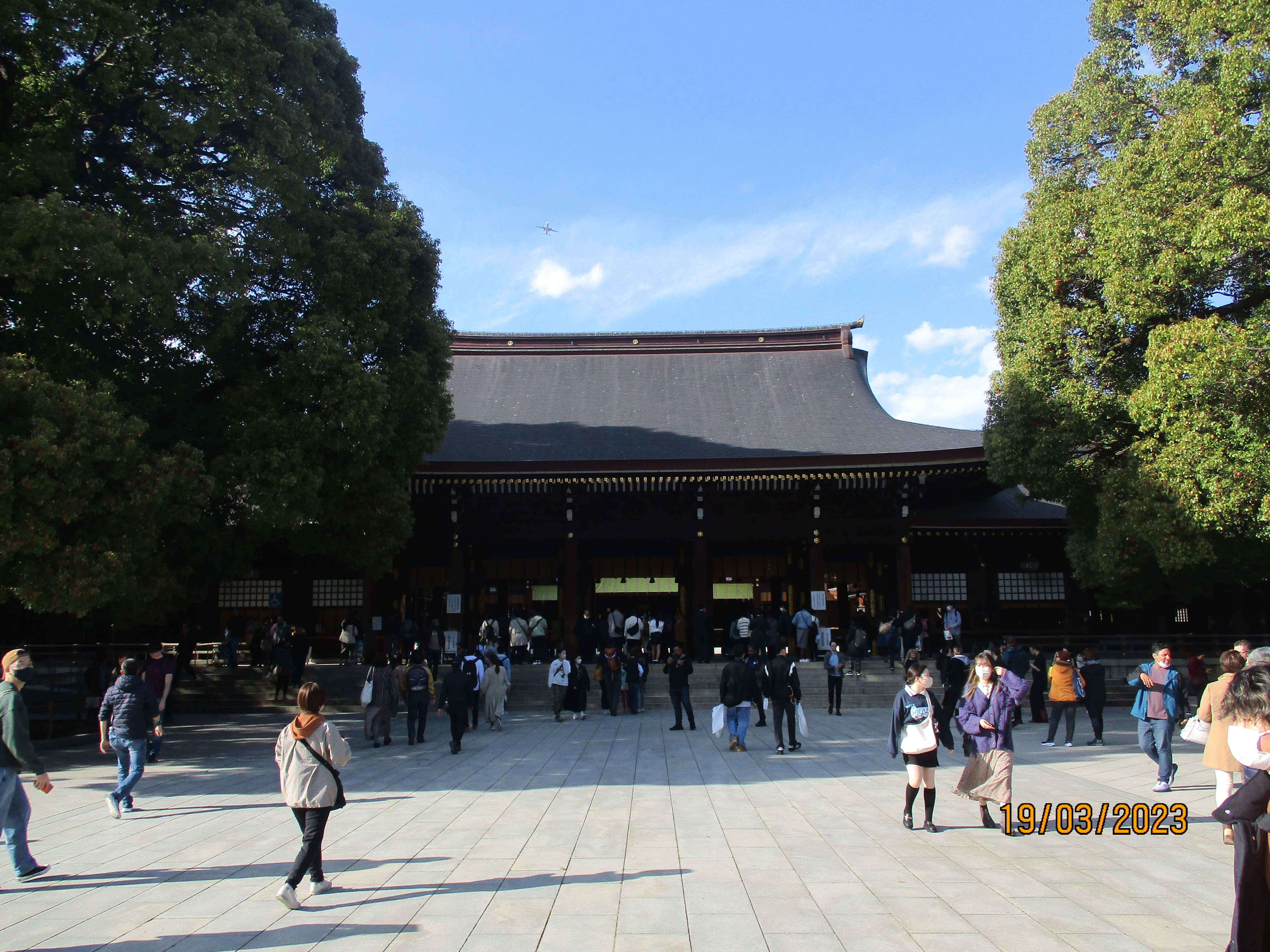
I was of course playing the tour guide for my brother but I obviously tried to include places I haven't been to myself. One of these was the shrine for emperor Meiji. He is the one who, with foreign "help", seized the power, took over the government and implemented reforms that would incorporate western ideas into Japanese society and culture, and rapidly industrialize the country as well. He is still worshipped for his role in putting Japan on the world map and laying the foundation for what the country is today.


Even though I had already been there many years ago, I simply had to take my brother to Senso-ji again, the massive red temple in Tokyo's Asakusa district. This time around the weather was lovely, so I will let the pictures speak for themselves.


From there it was not difficult to see Tokyo's tallest building, the Tokyo Skytree, towering 634 meters above the city. And no, nothing in the world will ever get me to go up there.


We are now on our way to Osaka, riding the famous Japanese bullet train. The 500 kilometers will only take us 2.5 hours. Everyone should be jealous of Japan's trains. Before hopping on the train, my brother and I picked up my girlfriend from the airport who just came back from a trip to Germany. I was glad I could meet her after a long time. This is us before parting ways again.


That's it for now. There are plenty of things we want to do while in Osaka so it won't be long before the next post.

See you then!
Nils

Friday, January 6, 2023

First time skiing at Zao

A happy New Year to all of you!

Or 明けましておめでとう if you prefer. I hope you all had a good start into 2023, the 5th year of Japan's era of harmony. I had a very relaxed start due to the fact that the university is currently closed to all students. The reason being the extensive entrance examination for all the prospective students. I honestly don't fancy being a high school student right now. Anyway, I went skiing just after Christmas. The university's skiing club that I joined had a two day training session at Zao. What is Zao? Well, thanks for asking. It kind of combines two of my favorite things. It is a skiing resort on the slopes of an active volcano. I wonder who saw that one coming...

It gets even better though. A bus from Yamagata train station takes you to Zao skiing resort in about 30 minutes. Can you believe that? Not only that, but a day pass for all the lifts is about 6000¥, which converts to about 40 €, or $45 US. Pretty good, huh? It all sounds too perfect, doesn't it? Well, since we can't have nice things I made sure that the weather was subpar. Only on a few occasions was I able to see more than 50 meters ahead of me. I thankfully had my camera on hand for those times. Count yourselves lucky.

On the first day we went to a small separate slope with the intention to give the beginners a fighting chance. The slope was very gentle for which I was grateful. I haven't stood on skis for about six years so having the opportunity to get a feeling for it again was desperately needed. Weather on that day wasn't too bad either. Here some impressions:


After spending a whole day on the beginner slope however, I craved MOAR. The second day took us to the proper resort. The whole area has around 50 km of connected slopes, which thankfully provided opportunities to all proficiency levels. After a day of warming up I felt like I could let loose. And damn did it feel good. I couldn't go all out though because poor visibility didn't allow it.


The snow was perfect, the slopes great, the company fun, and look where we had lunch (same building you can see in the distance in the photo above):


It almost felt like I was back in the Alps, almost. Great atmosphere. After lunch we went to the top of the mountain. If you are expecting a great view I am sorry to disappoint. I can however show you a picture of me sitting in the lap of the buddha at the mountain peak.


All this time it was snowing profusely. I have seen pictures of this buddha where only the upper part of its head is above ground. Crazy. I guess I'll be coming back. Another interesting feature of this mountain are the so called Snow Monsters of Zao, a fascinating natural phenomenon. Cold Siberian winds cover the fir trees in this area with freezing condensation. This, in combination with tons of snow fall, completely covers the trees in snow. It makes them look like otherworldly beings. This a picture of the early stages.


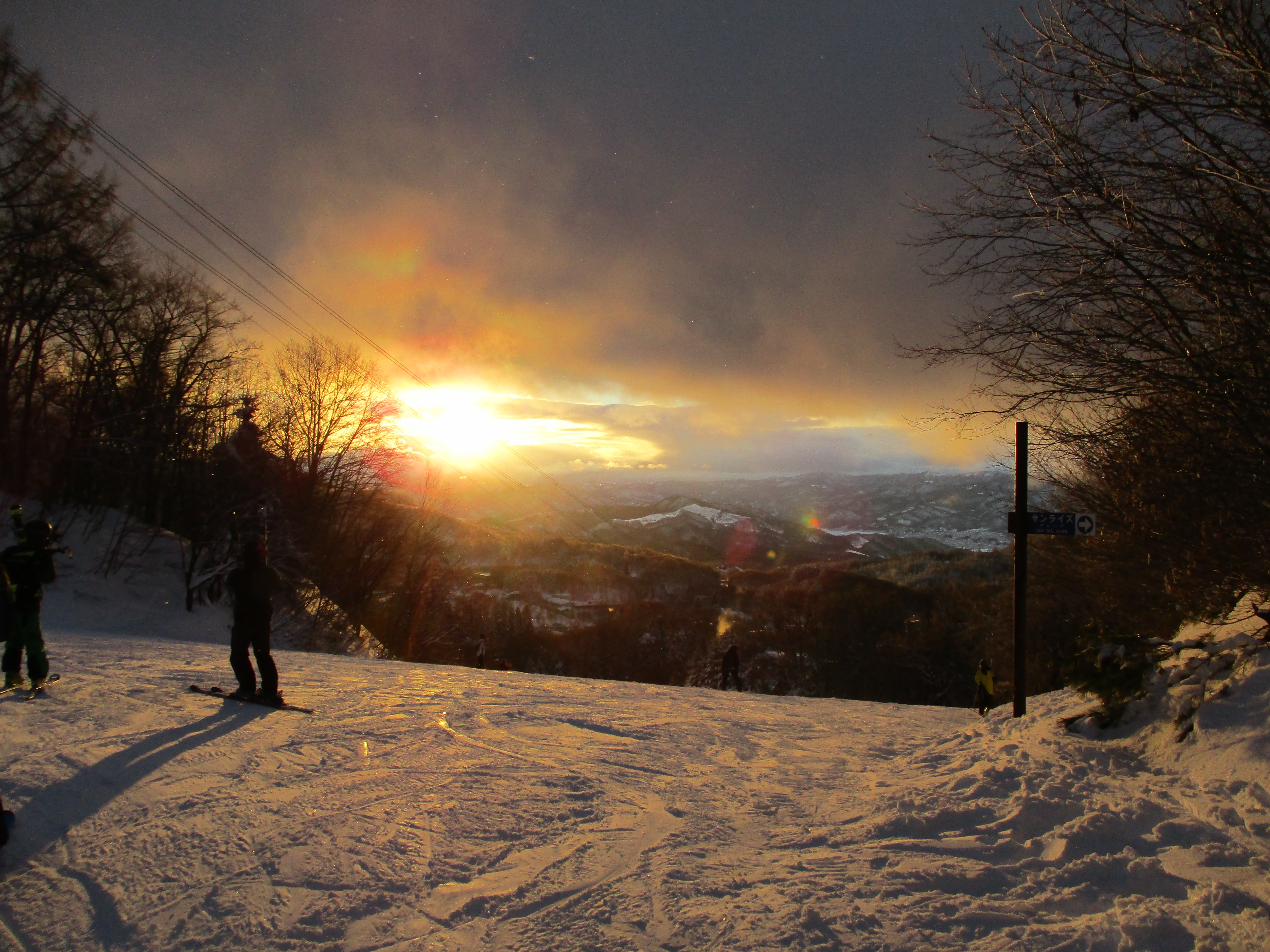
I'll get more pictures in February, when they won't look like trees anymore. On our last descent the cloud cover broke and revealed a previously hidden view of the fantastic landscape.


Even the sun graced us with an appearance. Nothing tops a sunset seen from a mountain.


I had a great time with the people from the skiing club, even if communication is still problematic. I am however making progress in my Japanese studies. I am no longer utterly clueless to what is going on around me. I guess I have officially left the toddler state and advanced to kindergarten. Rejoice!

That shall be it for now.

Proschd Neijohr!

Nils

Wednesday, November 23, 2022

Azuma Fieldwork V2

Greetings,

long time no see. It has been quite a while since my last post. Since arriving here I have made the unfortunate discovery that there is something you always seem to lack, and that is the time to sit down unperturbed for an hour two to focus on what is important to you, like for example, writing another blog post. Today however I find myself enjoying Japan's "Labor Thanksgiving Day", one of its many holidays. Yesterday I was asked if I would be going to University today. Perplexed I simply asked why I would be, it's a holiday after all. I now understand that holidays in Japan are just a suggestion. Nothing weird about celebrating "Labor Thanksgiving Day" by laboring away I guess. Anyway, a lot has happened since my last post and I have a lot of material piled up for more. Let me just start off with what's on top. Ahhh yes, more fieldwork at Azuma volcano!

Now with nice weather!

Azuma has become an important research subject for my project. The data we collect on volcanic bomb distribution and size serve as an excellent way to test out the new model I am developing. Inferring the physical parameters of the 1893 eruption for comparison with other methods is a great way to see if the model is doing its job properly. From there we can use it to do a statistical analysis to assess the hazard of potential future eruptions. For that we want data on around a thousand samples. Currently we have around 300. A long way to go. And since the road up to the volcano is closed during winter we used the last two weeks at the end of October to go there twice. The weather was much better than last time. Blue sky with the occasional cloud for the most part. Let me reveal to you what was hidden the last time!


That's the wooden path that crosses the swamp that was previously mostly concealed by fog.


Here you can see the cliff with the huge fumarole constantly spewing sulfur dioxide into the air.


The huge bomb that you can find when going up the path to the top. I had to take a picture again, it is just to impressive.


Now you could also see Azuma-Kofuji in all its glory. The smaller crater is to the right is Okenuma. It's filled with water and surrounded by trees. It is actually older then Kofuji and therefore covered by the products of its eruption. I am amazed it still has its distinct crater shape despite that fact. Kofuji erupted between 4.8 and 5.9 thousand years ago. It produced 99 percent of the erupted material of the current phase activity of Azuma, which began when a huge part of the mountain collapsed and formed a horseshoe shaped caldera facing westward, towards Fukushima city. That was sometime between 100 and 280 thousand years ago.

Since all the snow had melted we were able to go higher up the mountain than we were able to in June. This here is a crossroads between the many peaks and the part with the brownish grass is another swampy area. North (right in the picture) you go further up towards other craters that formed in this latest stage. If you continue west (straight ahead in the picture) you'll get to a small lake. Unfortunately we weren't there for leisure, so this is as far as we went. Beyond this point we don't expect to find bombs from the 1893 eruption, but a closer look is warranted in the future.

We spent more time that day collecting data than we expected. You would expect that not to be a problem but the road up the mountain is actually closed during the night. When we came back to the parking lot our car was the only one left. The people were actually waiting for us and were quite relieved to find out that the car belonged to us. I guess they didn't fancy to go looking for some lost hikers. We passed the gate at the foot of the mountain, which closes at 5 pm, with three minutes to spare. The guy was already standing there to look it shut. We all learned a valuable lesson that day: Unless you want to spend the night in a single car with four people, you better keep an eye on your watch.

As a little bonus, since you had to wait so long for a new post, here are some pictures from my trip to a local museum about "benibana", or Japanese safflower. It is a yellow to orange flower that was and still is used to dye cloth. The museum was the mansion of a rich merchant family back in the day. The trip was organized by the university for all the international students to show us around the prefecture.


The main entrance. Quite a sight.


Imagine having your own bloody moat around your house. Money isn't everything in life but having a little extra sure doesn't hurt, be it now or in the past.


Fishies!


The interior of the estate was nothing to sniff at either.


Look at how much swag they had back then. Nothing today remotely comes close to this much swag.


I was also there by the way.

And that is it for today. The next time I have s few hours to myself I will work on the next post. Until then!

Nils